

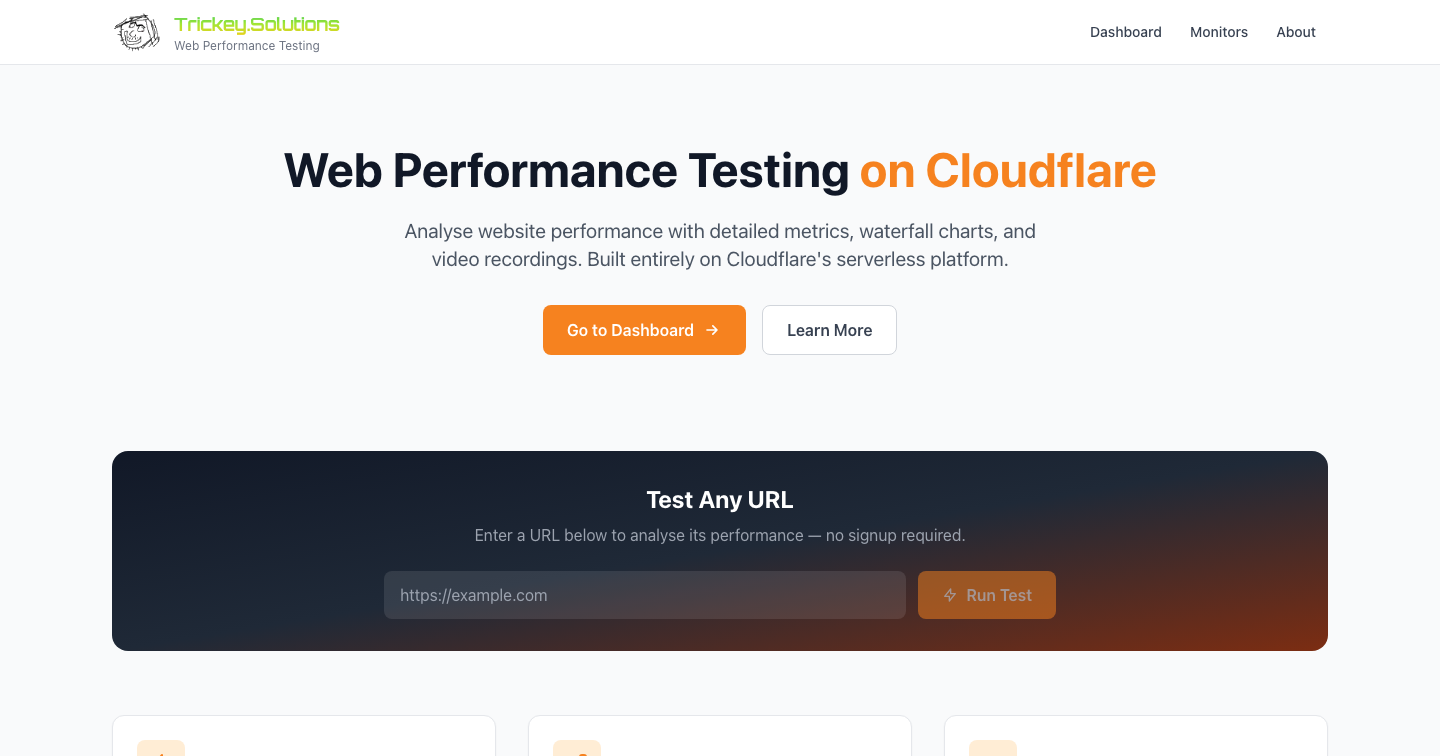
Analyze website performance with detailed metrics, waterfall charts, and video recordings, all built on Cloudflare's serverless platform.
Site Confidence — Web Performance Testing on Cloudflare
A serverless web performance testing platform that captures Core Web Vitals, HAR waterfalls, and video recordings using 10+ Cloudflare products.
About Site Confidence
Site Confidence works like a self-hosted WebPageTest. Enter a URL, and the platform loads it in a headless Chrome instance via Cloudflare’s Browser Rendering API. It captures Core Web Vitals (LCP, FCP, CLS, TTFB), generates a HAR waterfall chart of every network request, and records a video of the page load.
Test results include cache analysis (Cloudflare cache hits vs. misses), preload detection (resources loaded via preload, prefetch, or early hints), and request mapping that visualizes third-party domain relationships. The entire test runs as a Cloudflare Workflow with automatic retries, so transient failures don’t lose results.
Each tenant gets isolated storage through a Durable Object with SQLite. Test results stream to the browser over WebSockets as they complete, and finished artifacts (HAR files, screenshots, MP4 videos) are stored in R2.
Frameworks & Technologies Used
- Frontend: Astro with React islands and Tailwind CSS (SSR with interactive components)
- Backend: Cloudflare Workers (API routes and orchestration)
- Browser Automation: Browser Rendering API with Puppeteer (headless Chrome)
- Video Processing: Cloudflare Containers with FFmpeg (MP4 generation from screenshots)
Why Cloudflare for This Project?
- Browser Rendering for Real Measurement: Tests run in headless Chrome through Cloudflare’s Browser Rendering API. No third-party browser farm needed. The browser runs on Cloudflare’s infrastructure alongside the Worker that orchestrates it.
- Workflows for Reliable Test Execution: Each performance test is a Workflow with automatic checkpointing and retries. A timeout or network issue doesn’t lose a test that’s already partially complete.
- Durable Objects with SQLite for Multi-Tenancy: Each tenant’s test history lives in a Durable Object with its own SQLite database. Data isolation comes from the architecture itself, not from query-level filtering.
- R2 for Artifact Storage: HAR files, screenshot filmstrips, and MP4 recordings go to R2. Tests generate significant data per run, and R2 handles it without egress fees when users download results.